

My sons will attend Tam High this fall, one of several high schools in the Tamalpais Union High School District, where I’m running for school board. In 2024, the school district published a land acknowledgment on its website declaring that the district stands on “unceded stolen ancestral land.” The acknowledgment presents an opportunity to ask and discuss a question: How should our public high schools talk about the subject of political legitimacy?
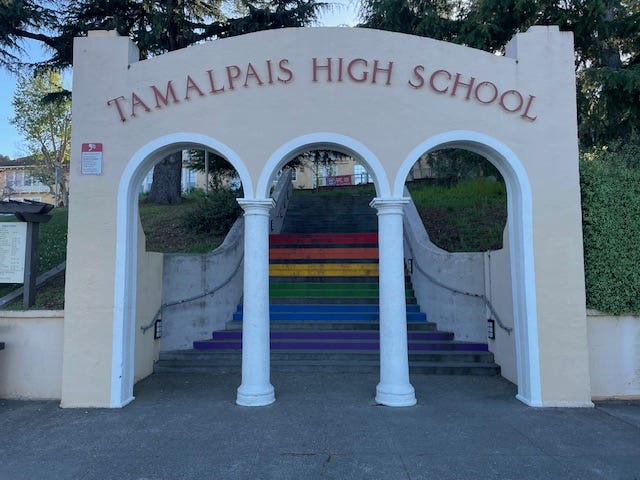
I will argue here that the land acknowledgment is statement about political legitimacy and not a history lesson. Teaching about this subject is inherently difficult. But I think the school will better serve its students if it suspends judgment and demands reasoning and argument, not allegiance to the school’s own conclusions.
I. Learning about the school district’s land acknowledgment.
Let’s start with the Tam Union High School District’s land acknowledgment.
Here it is:
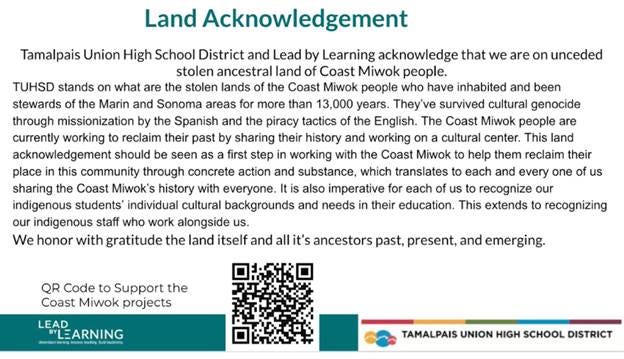
Before I wrote about this particular land acknowledgment, I wanted to learn more about it. Here’s what I found.
Public records request
The school district published this land acknowledgment on its website in May 2024. About one year later, I submitted a public records request to the district, asking for all records relating to the land acknowledgment. The school district responded that it had no records and did not know when the land acknowledgment was posted to the website.
QR Code
After receiving no information from the school, I followed the QR Code “to support the Coast Miwok projects” on the land acknowledgment page, which led to a gofundme page for “Coast Miwok of Southern Marin Project” (the link is now broken). Links on the gofundme page led to the Coast Miwok of Southern Marin Project, which listed contact information for Lucina Vidauri, Olompali Elder. I asked Ms. Vidauri whether she had authored the land acknowledgment and she replied that she had not. She suggested that perhaps the Coast Miwok Tribal Council of Marin was involved. Later, when I asked the Tribal Council if one of its members authored or advised on the land acknowledgment, its representative replied that no one currently serving on the Tribal Council had been involved or consulted on the land acknowledgment.
Lead by Learning
The first line of the acknowledgement and the footer both reference a group called Lead by Learning, which is part of Mills College. A Lead by Learning representative informed me that the land acknowledgment currently posted on the school district’s website is a photo/screenshot of a slide from a retreat that Lead by Learning and the school district hosted in 2022. Lead by Learning stated that it did not produce the land acknowledgment; rather, the district did. It recommended that I reach out to an assistant superintendent and a teacher who led the land acknowledgment at the retreat to learn more.
I asked an administrator if she could speak with me about the land acknowledgment. She replied and asked what questions I had, but then did not respond to my questions. This was the end of the road.
II. Why the land acknowledgment is a statement about political legitimacy.
Going right to the key claim, the acknowledgment’s text begins: “Tamalpais Union High School District and Lead by Learning acknowledge that we are on unceded stolen ancestral land of Coast Miwok people.” And the next line states, “TUHSD stands on what are the stolen lands of the Coast Miwok people who have inhabited and been the stewards of the Marin and Sonoma areas for more than 13,000 years.” These are claims about the present status of Tam District itself.
When the land acknowledgment speaks of “stolen lands” and the “stewards of the Marin and Sonoma areas,” it is not talking about a discrete property crime, but the loss of self-governance by tribal groups. At its core, the land acknowledgment claims that tribal groups had a right to govern that persists into the present day, which is why the lands remain “unceded” and “stolen.” It is not any individual’s right to live in Marin County that has been lost or any specific lot, but tribal groups’ governance or control over an entire two-county region. The descendants of the Coast Miwok live and work in Marin and Sonoma today, and in that sense, they enjoy the land today just as others do. What has disappeared – what has been “stolen” – is the Coast Miwok’s historic sovereignty.
Put another way, the land acknowledgment is not about who owns or lives on certain parcels of land in the sense of a dispute between property owners or claimants under one government. Rather, it references a dispute between rival nations or political factions about which government is legitimate. Claims that a government—here, the public school district—stands on stolen land are ultimately claims about who has the right to assert sovereignty.
Some may argue that the historical facts are uncontested. But even uncontested facts do not produce uniform interpretations about what those facts mean. The meaning of historical facts depends on political philosophy. If there are reasonable competing claims, then schools ordinarily should present them and let students analyze those claims. Teaching more than one perspective should lead to better thinking and student outcomes.
III. The difficulty of teaching about political legitimacy.
The role of schools is to demand fair, evidence-based analysis. Unfortunately, the land acknowledgment demands allegiance instead. This may have been easier on some level than living with uncertainty or asking students to consider whether a government that acquired its sovereignty over territory through conquest is legitimate. That question, in turn, requires students to ponder the foundational basis for government legitimacy, and already we are deep into philosophy with no simple way out.
Some may argue that the descendants of the first people who inhabited Marin County have the strongest claim to the land and sovereignty over it. They may claim that a people’s continuous occupation of a particular territory supports an ongoing claim to that territory even after conquest. Others may argue that legitimacy turns on whether the people can participate in self-government by electing leaders. They would say that democracy and shared ideals are the foundation of legitimacy, not continuous occupation. I think both strands of thoughts are prominent in most disputes between nations all over the world. One group claims ownership through long occupation; the other claims the will of the people. Both have significant arguments to make.
Should a school or teacher recite historical facts and then draw firm conclusions about present-day political legitimacy based on those facts? If they do, they mistake certainty about evidence for certainty about analysis. These are not the same thing. But everyone wants the answer: what is right? Schools probably should resist drawing that conclusion for students, and insist instead on reasoning. This will require suspending judgment and letting inquiry play out, even when or especially when we as parents, educators, and civic-minded citizens are eager to supply the answer.
At bottom, an approach that allows students to weigh the evidence and arguments demonstrates faith and commitment that rational inquiry will lead, eventually, toward better answers. A good teacher can guide the discussion by probing logical reasoning and evidence without demanding conclusions. Whatever the District says about the land upon which it stands, it owes students that same discipline.
* * *
For those who want more detailed history, I put it in this endnote.1
California’s first settlers came from Asia thousands of years ago, crossing the Bering Straits into Alaska, and then traveling south along the coast. Some of them lived in small bands in Marin County, where they hunted salmon and deer and gathered acorns for food. Their cultural tradition had its own mythology, art, and dances. Before the 1700s, these people—those who eventually became known as the Coast Miwok—had little contact with Europeans. In the 1770s, an estimated 1,500 to 2,000 Coast Miwok lived in the area now known as Marin and Sonoma.
In the late 1700s, Spanish missionaries traveled north from Mexico and established missions in the San Francisco Bay Area. They sought to convert the native inhabitants to Christianity. The missionaries forced the native inhabitants to live in missions such as Mission San Francisco de Asis and Mission San Rafael, where conversion involved learning Spanish and the tenets of Christianity. Because of forced missionization, the Coast Miwok were unable to practice and thus lost some of their cultural traditions.
In 1821, Mexico won independence from Spain and sought to end the mission system. In 1834, Mexico freed the Coast Miwok from the Spanish missions, but it did not help them to return to their former way of life. Some were enslaved. Many died of smallpox and other diseases. Mexico granted the lands of Marin County to Mexican and Spanish settlers and their descendants, not the Coast Miwok, with two significant exceptions.
The Mexican government granted Rancho Olompali, consisting of around 8,900 acres to Camillo Ynitia, who had been the headman of his village. In 1852, Ynitia sold most of the land to James Black, retaining 1,480 acres for himself, which his daughter later sold. The State of California eventually purchased 700 acres of the Olompali lands in 1977, and the area is now Olompali State Historic Park, near Novato.
The Mexican government granted Rancho Nicasio, consisting of around 80,000 acres, to a group of around 500 Coast Miwok. But it did not honor the grant. In 1844, it granted much of the same property to Spanish officials. In 1846, American settlers in Sonoma County declared that California was an independent republic in the Bear Flag Revolt. In the Mexican-American war, the Sonoma rebels joined the United States in battles against Mexican troops. In 1847, troops from Iowa and New York arrived in California to find that the war was over.
After California joined the union in 1850, the new state established a commission to hear claims about who owned land. In 1855, the Public Lands Commission rejected a claim by Coast Miwok claimants that they owned Rancho Nicasio, siding instead with the claimants of Spanish descent. By 1880, only about 60 Coast Miwok lived in Marin County.
Today, two tribes represent the Coast Miwok in Marin County—the Federated Indians of Graton Rancheria and the Coast Miwok Tribal Council of Marin. In the 2000s, the Graton Rancheria purchased 254 acres of land for its reservation near Rohnert Park. In 2023, the Tribal Council of Marin purchased 26 acres of land in Nicasio, with the assistance of donors.
Sources:
Coast Miwok of Southern Marin Project
Coastal Miwok Tribal Council of Marin
Federated Indians of Graton Rancheria
Library of Congress, Early California History: An Overview
Miwok Archeological Preserve of Marin
Olompali State Historic Park - Heritage
Randall Milliken, Ethnohistory and Ethnogeography of the Coast Miwok and Their Neighbors, 1783-1840 (June 2009), available at https://www.nps.gov/goga/learn/historyculture/upload/2009-Final-Coast-Miwok-Report.pdf
The World Encompassed by Sir Francis Drake [excerpt available at https://nationalhumanitiescenter.org/pds/amerbegin/contact/text5/drake.pdf]