YES to the phone ban, NO to Yondr pouches
A bell-to-bell ban would be great progress.
Should the school district prohibit students from using phones during the entire school day, from bell to bell? And if so, should the school buy and distribute Yondr pouches to hold students’ phones during the school day?
My answers: Yes to the phone ban, no to the Yondr pouches.
The school district should prohibit students from using their phones on campus during the entire school day, including during passing times and lunch. In fact, unless a parent gives informed consent, the school district should prohibit students from bringing phones on campus altogether. If a parent does give consent, then the student should keep his or her phone in a backpack or bag with the power turned off while on campus. The school district should not buy Yondr pouches. The Yondr pouch is just another bag and requires just as much enforcement effort as ordinary backpacks.
The school district’s current policy and this year’s meeting to discuss the policy
The current policy prohibits phone use during class, but expressly authorizes phone use during “non-instructional time,” i.e., during passing time between classes and during lunch. As a result, phones displace social interaction. The phones distract students during class too, even when they’re not holding them—students look forward to texting and watching videos and checking all their app notifications in between classes. Their cravings for their phones would subside if they were not looking forward to using them during passing time and lunch.
On March 24, the Tamalpais Union High School District held a meeting to discuss these issues. It was a long and thoughtful discussion. I was there in person for about half of it, then watched the rest on the video recording online.
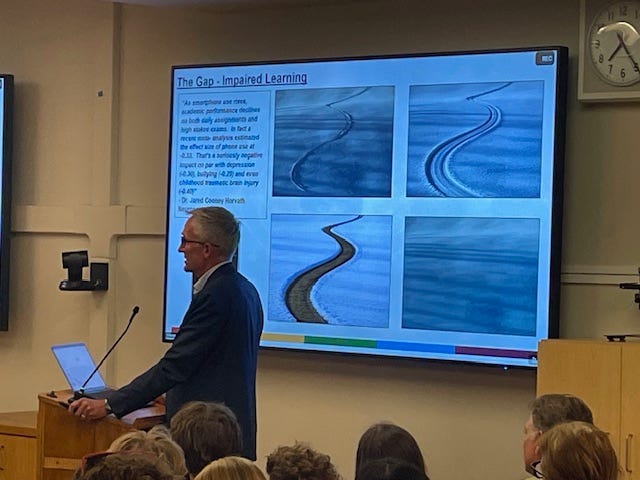
(my photo of Superintendent Goode speaking at the March 24 board meeting)
All five board members and virtually all speakers strongly favored a phone ban, meaning that students would not have access to their phones during the entire school day. Beneath the surface, there was much less consensus. The board members and public attendees did not agree on when or how to implement or enforce a phone ban, probably because they do not share the same underlying assumptions about harm, student motivation, or the efficacy of the Yondr pouch system.
For example, if we have discovered or reached a consensus that phones are extremely harmful, like heroin, then we should not wait another second to act. In that case, we should treat phones like illegal contraband starting today. Phones would be illegal; bringing them on campus would result in suspension or expulsion. But nobody thinks that. At the meeting, many commenters looked down at the phone in their hand as they recited their notes about why phones are harmful. This would be like shooting up at an AA meeting, if phones were drugs, which they aren’t.
All the same, I am absolutely persuaded that phones are harmful in their own unique way and that students are not mature enough to consent to the harm. I read the Anxious Generation and follow Jon Haidt. Everyone at the meeting seemed to agree that something must be done. The hard remaining question, which the school district did not convincingly answer, is which policy response is appropriate. The proposal on the table apparently is to spend $175,000 over two years on Yondr pouches.
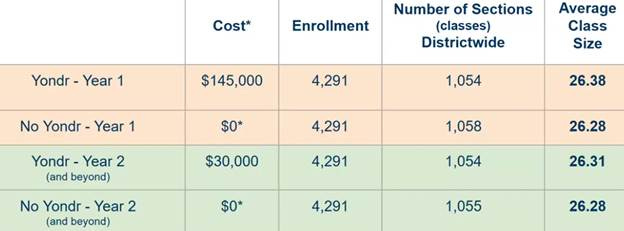
(This is a screen shot from the recorded presentation that appears around the 2:11 mark.)
The school district should not buy Yondr pouches
The proponents of Yondr pouches, including superintendent Goode, argued that a policy that requires students to leave phones in their backpacks all day will not work because the phones are too addictive. Many students, he reasoned, are incapable of resisting the urge to look at their phone unless it is locked away. This reasoning places Yondr pouches squarely in the category of enforcement device, like an ankle bracelet for parolees. If it’s an enforcement device, then the next question is whether it will work—or instead whether kids will easily jail-break the device. If the Yondr scheme is meant as enforcement and it is trivially easy to defeat, then it is pointless.
The simplest way to circumvent the enforcement program is to put an old phone or maybe a decoy in the pouch at the locking station and keep the real one in the backpack. (Don’t worry, nobody with a serious phone addiction could possibly read this far and get these hot tips.) One administrator of a large school district in Oregon estimated that about half of students were putting a burner phone in the Yondr pouch. Or students can just skip the locking station altogether and enter campus another way. The only way for the school to counteract that gambit would be to force students to pass through a particular entrance and then make the student prove to a staff member that the phone he or she is locking in the Yondr pouch is his or her actual phone—the one with a working phone number and everything. That is logistically impossible. The best the school could do would be random spot checks, which would be invasive and time-consuming. The kids also say that you can open the Yondr pouch with strong magnets, which, again, renders the pouches useless.
In short, the Yondr pouch solution assumes the existence of students who are too addicted or motivated to resist the phone when it is inside a backpack, but not so addicted or motivated that they will try to overcome the Yondr system. I think that category of students is very small. Think about a population distribution with “motivation to access phone” as the variable on the x-axis and the number of students with that level of motivation on the y‑axis. I made an awesome chart to illustrate:
Awesome chart
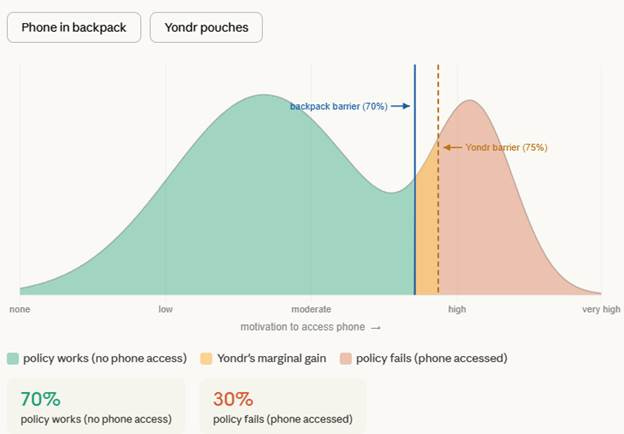
I am guessing that a large group of students, represented by the green peak above, has a moderate desire to use their phone and another group of students, represented by the red peak, has a strong, addiction-level desire to use their phones during the school day. The chart shows that as motivation to access the phone gets stronger, the policy eventually fails to deter or restrain the student and he or she accesses the phone during the school day.
In this illustration, a backpack policy works for 70% of students—they follow the rule and do not access their phone during the school day. The Yondr policy works for 75% of students. The suggestion here is that the Yondr pouches make only a tiny difference because the same students who will break the backpack rule will also break the Yondr pouch rule, although the Yondr pouch may deter an additional 5% of the student population from using their phone while on campus.
To be clear, I am making up these numbers for the purposes of thinking through the problem. We could also create a chart for a world in which the Yondr pouch is transformational as compared with a backpack policy. Here it is:
Totally unrealistic chart
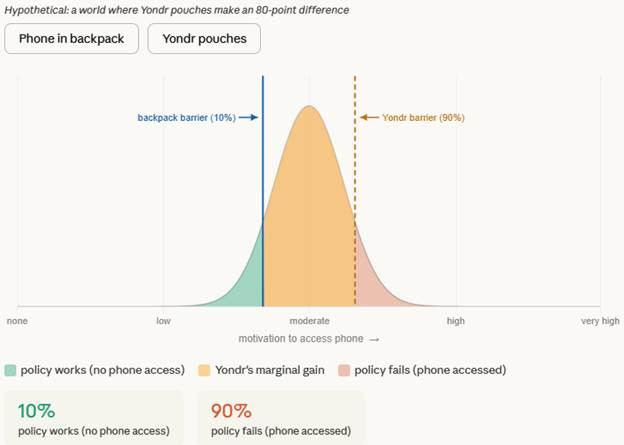
In this chart, the backpack policy failed for almost everyone—only 10% of students did not access their phones under a policy that requires students to keep their phones in backpacks. But the Yondr policy worked for 90% of students, an eighty percent jump! This kind of chart just doesn’t make sense though. If the backpack-only policy doesn’t work for almost everyone (90% of students), that means that those students are not rule followers or are just too addicted to control their own behavior. It would be weird, then, to find that this very same group fell in line and followed the rule or gave up when confronted with the Yondr pouch. (This chart might make sense if the Yondr pouch required extraordinary motivation to defeat, but it doesn’t; defeating it seems quite easy.)
At any rate, these charts are intended to make a point: to decide whether the Yondr pouches are useful, the school district will have to make some factual determinations or assumptions about their marginal benefit, as compared with other phone-ban policies. And I am not seeing any marginal benefit to Yondr pouches, as compared with a policy that requires students to keep their phones in their backpacks.
Yondr proponents also underestimate the burdens of the Yondr system
Some administrators argue that the reason to prefer Yondr pouches, as compared with backpacks, is that Yondr pouches relieve teachers of the burden of enforcing the rules. But that would only be true if the Yondr pouches are substantially more effective than a backpack-only policy, i.e., if we lived in the world depicted by the totally unrealistic chart. In that world, almost everyone breaks the keep-it-in-the-backpack rule, requiring constant vigilance and enforcement by teachers, but almost everyone follows the Yondr pouch rule, requiring relatively little teacher enforcement. Journalists report that, just like a backpack policy, a Yondr policy is only as good as the district’s willingness to enforce, and no better.
In reality, I think the Yondr pouch program would require considerably more staff time because somebody has to supervise all those locking and unlocking stations and manage the hardware. Our oldest son attends Tam High and our youngest will start next year. Tam High is a beautiful, open-to-the-outdoors, California campus with many entry points. This is fantastic, but for a Yondr system to work, the school would have to funnel kids into main entry points and guard against “unlawful entry” where it does not maintain Yondr locking stations. That would require tremendous resources. There is no way to “guard” all the entrances at Tam High. That means students could walk right into class without locking their phone—the Yondr system is no better than a backpack policy. Yondr is literally just another bag. Whether it holds a real phone depends entirely on the school district’s enforcement commitment.
A backpack policy doesn’t require all the locking supervision. And I assume that about the same percentage of kids will be circumventing the rule under both policies, so teachers would be doing almost exactly the same amount of enforcement under a backpack or Yondr policy. Yondr seems to be creating additional work, not reducing it. This explains why the Folsom school district tried Yondr pouches but found they were “more trouble than they were worth.” An opinion piece reports that the Los Angeles rollout of Yondr pouches was a total failure because the pouches are ineffective. The New York Times covered this failure and others.
I want to be clear: if the choice is between the current policy (phone use explicitly authorized on campus during all non-instructional time) and a phone ban implemented via Yondr pouch, then I would choose the latter and would congratulate the board on that progress. This is because the first part—the total ban—is the most important part. I just happen to think that, although reasonable minds can differ, an even better solution is to implement a phone ban where students simply keep their phones in their backpack or bag, powered off, while on campus. And then I would go further.
Another approach: a default ban with a parental override option based on informed consent to carry in a backpack or bag
Here is another idea. It is in some ways more radical than the options on the table and in other ways more flexible. The proposed approach is simple: phones are completely banned from campus by default. Students leave them at home. This is the norm, the expectation, the baseline. Under the baseline policy, it is true, students would not have a phone at lunchtime. Students who leave campus for lunch could do so without phones, as generations of students did before them. If an emergency arises, students would have access to a phone because, in our community, students are never more than a few steps from an adult with a phone. Under our current cultural settings, most kids and parents would not want this. So they could opt out.
Parents who wish to override the default ban could do so, but only after submitting an informed consent form. An online form would present the relevant research clearly and honestly: that smartphones are highly addictive by design, that they impair the ability to focus and sustain attention, that they disrupt learning, and that heavy adolescent phone use is associated with increased anxiety, depression, and impaired social development. After reviewing this information, parents who still wished to allow their child to bring a phone to campus could submit the consent form and their child would be permitted to do so. The parent could override the ban for any reason or no reason; no explanation required.
Students with permission could carry their phone in a backpack or bag, so long as the power is turned off and the student does not access the phone during the school day. This is the phone-ban described above; the difference I’m proposing here is that informed parental consent should be required even for this level of concealed carry.
The goal of this informed-consent approach is medium and long-term cultural change. A culture of immersive phone use did not spring up overnight; it took years for us to acclimatize to our current levels of phone usage. Similarly, we probably cannot expect to banish phones from campus overnight. In the first year of such an informed-consent program, I bet that something close to 100 percent of returning students would persuade their parents to give consent, so that they could bring their phones on campus. But what about students who are coming up after them?
In successive years, as awareness of the harm caused by phones continues to grow, the percentage of parents who allow their children to bring their phone to school may well decline. The ultimate goal for many of us is a phone-free education and childhood, full stop, not highly-regulated and closely-monitored phone possession. The phone didn’t crowd out childhood in a single season – and we can begin clearing space one school year at a time.

Photo of white fidget spinner above by Sebastian Voortman. Photo of spinning and blurred fidget spinner accompanying article by David Bartus.