

This year, a Paris woman reportedly threatened to sue the Tamalpais Union High School District for defamation if it did not take down an Instagram post within 48 hours. The post, published on the Instagram channel of the Redwood Bark, a student-run journalism outlet at Redwood High School, was about Marin towns mentioned in the Epstein files. The post states, “Mill Valley was mentioned in the context of providing models to Epstein from a woman named Gisele Attias Bonnouvrier, who was associated with two companies that could not be tracked.”
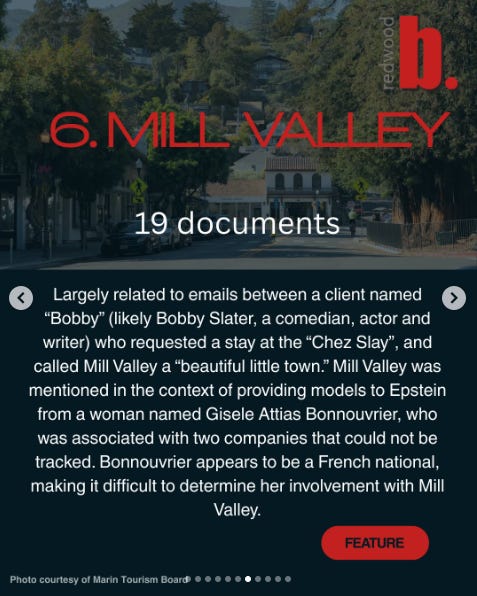
After receiving the litigation threat, the superintendent asked the Bark to redact Bonnouvrier’s name in the post. The students concluded that they could not redact the post and took it down instead. The students restored the post after a meeting with the superintendent. Wired magazine covered the episode, shining a light on questions about whether and when school officials should require students to redact or take down already-published articles and posts. Here, as many have argued, the school district did not need to ask students to redact or take down the post, even temporarily. Written guidance would help administrators respond to the next incident.
Existing school board policy and regulations regarding student-run publications
Under board policy 5145.2 and California law (Education Code § 48907), students have a right to free speech, but that right is not absolute and does not include a right to publish libelous statements. Libel is a false, non-privileged statement that injures someone’s reputation. Civil Code § 45. Existing board policy prohibits students from posting libelous statements.
The district’s administrative regulations provide that a school may sponsor an official student-run publication, such as the Redwood Bark. The regulations seem to require a school employee to review articles or posts before the Bark (or other publication) publishes them. Regulation 5145.2 states that each student publication shall have an official publication advisor who is responsible for “supervising each publication, prior to its publication, to determine if it satisfies all the conditions of these guidelines.”1 Under board policy, school employees may not restrain publication unless they conclude that the publication would violate rules against libel, obscenity, incitement, or other standards.
I find no board policy or administrative regulation specifically addressing complaints or a threatened defamation lawsuit against the school district based on articles or posts that an official student-run publication has already published. This potential gap in the Tam District’s policy and regulation framework may have led to an ad-hoc emergency response when the reported threat from Bonnouvrier arrived.
Assessing the email: Did the district face liability risk?
This litigation-threat incident did not present an easy legal question for administrators. The statement about “providing models to Epstein from a woman named Gisele Attias Bonnouvrier” could mean different things, some innocent, some not. Let’s assume that some readers would interpret the Instagram post to mean that Bonnouvrier provided models to Epstein. The school district has no realistic way of knowing whether that statement is true. Under the circumstances, the best the school district can do is assess whether the Bark accurately characterized an email in the public record.
According to an email I downloaded from the Justice Department’s public repository of “Epstein files,” on October 8, 2013, Bonnouvrier sent an email to an unknown person, whose name and email address are redacted. Assuming the email is authentic, Bonnouvrier states various prices in Euros for introducing models, sponsoring events, being a “correspondent in Paris.” Toward the end of the email, Bonnouvrier states, “Regarding [redacted], my Austrian model, we can come and see you this evening if you are interested, and in that case let me know how can I get my fees.”
Bonnouvrier’s own email reflects that she pitched models to Epstein, meaning that she was willing to provide them.2 Because the gist of the Bark’s statement about “providing models” was not much different from “pitching models,” the risk that the district could be held liable for defamation seems low.3 Making that assessment requires some knowledge of defamation law, however, as well as review of the primary sources. Busy administrators cannot conduct defamation analysis on a short deadline. They need guidance.
New guidance for responding to litigation threats
In the absence of clear written policy, the superintendent responded to a complaint to protect against perceived danger to the district. To prepare for the next incident, however, the district should develop guidelines for responding to defamation threats and other take-down requests, which will protect both the district and students.
The board could direct the superintendent to develop a regulation, consistent with its free speech policy (Policy 5145.2), that guides the district’s response to defamation threats. The new regulation would balance the school district’s potential liability for defamation, students’ speech rights, and the core purpose of a student-run newspaper, which is to educate and train students in journalism. Students do not have the right to publish defamatory statements. Inevitably, district administrators, together with counsel, if necessary, must decide whether a published statement is defamatory.
Thus, after receiving a complaint that a publication is defamatory, the district should consider the issue carefully. Absent a threat of imminent harm, the district should not rush. Deleting or taking down a defamatory statement that already has been published does not make liability for the initial publication go away. There is no emergency because the publication has already happened and any initial liability has already been incurred.
Careful investigation is necessary because the district has some risks in either direction. In the case of a defamation threat, the publication has already occurred, but damages may increase if no correction or retraction is published within a reasonable period of time. Conversely, if the district requires a student-run outlet to take down an article whose publication the law protects, the district could face a lawsuit from the student or the student’s parent, as in Smith v. Novato Unified School District, 150 Cal. App. 4th 1439 (2007). How much investigation each situation requires will be dependent on the statements at issue, and as a general matter, administrators need not request deletion or retraction as a first step.
In some situations, school officials may want to act immediately, as when a publication potentially defames other students at the same school, which may constitute ongoing bullying or risk inciting violence. Because determining whether a statement is true or privileged may be difficult or impossible, school officials should focus in the first instance whether a harmful statement is likely to cause additional harm if not deleted.
This case involving “Marin mentions in the Epstein files” lies at the other end of the spectrum. Bonnouvrier’s email already appeared in a public repository of documents; the Bark mostly just drew attention to it; leaving the post in place during an investigation would not seem to cause any additional harm. Therefore, if administrators had the benefit of further guidance, they likely would have left the “Marin towns” post in place while they considered the defamation complaint.
In addition, the school principal or designee “may review copy prior to its publication, upon reasonable belief that it violates these guidelines.” If “a disagreement arises” about whether “an article should be printed,” a school may have a publications board that resolves the disagreement.
While Bonnouvrier named her French company “Mill Valley Connection,” I find no evidence that she or her company had any tie to Mill Valley, California. The company “Mill Valley Connection,” with an address that appears to match the partially redacted address in the email, was registered in France in 2008 and dissolved in 2018. The California Secretary of State’s lookup function returns no matches for “Mill Valley Connection.” It seems that a French woman owned a French company called “Mill Valley Connection.”
Disclaimer: I am not counsel to the district and this is not legal advice. But for purposes of commentary, I note that a plaintiff seeking to hold the school district liable for defamation would need to overcome public entity immunity, in addition to showing that the published statement was false and defamatory. A public entity like a school district may be held liable for acts and omissions of its employees acting within the scope of their employment, unless the employee is immune from liability. Gov’t Code § 815.2. Thus, to hold the school district liable for the initial publication, the plaintiff would need to show that a school employee negligently or willfully caused the publication of defamatory statements. And as FIRE observes (page 3 & footnote 22), the school district presumably would also assert fair report privilege under Civil Code § 47(d).